
By Lynn Buske
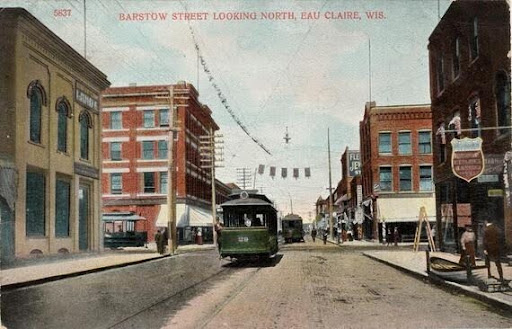
August 7, 2026 was the 100-year anniversary of when Eau Claire had a public transportation system that connected Eau Claire and Chippewa Falls. The JONAH Transportation leaders and members of The Chippewa Valley Transit Alliance wanted to share this history as a reminder of what we can have again in the future through passing a bill that would allow for municipalities to set up their own Regional Transit Authorities (RTA).
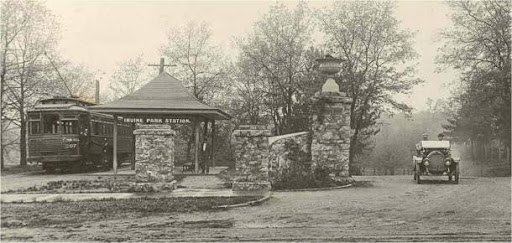
Figure 1: Trolley stop at Irvine. Photo from Chippewa County.
The Eau Claire interurban and streetcar system ran from 1879 to 1926. It connected downtown Eau Claire, Lake Hallie, and Chippewa Falls beginning with horse-drawn cars, and then moving to electric trolleys in 1889. It was one of the first in the nation! It eventually expanded to 12 miles, thanks to the Chippewa Valley Electric Railroad, from downtown Eau Claire through Lake Hallie to Irvine Park in Chippewa Falls.
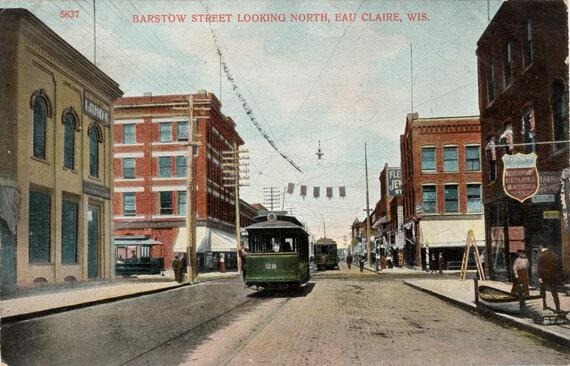
Figure 2: Trolley line down Barstow St. in 1907 from Wikipedia.org.
In 1926 the trolley system stopped. Buses and cars became prominent.
From then on, according to Chippewa County and a few of our members who were riders, the privately-owned Eau Claire Transportation Company operated a regular motor bus route that directly connected downtown Eau Claire to Lake Hallie and Chippewa Falls. Sounds great, right?
In 1975, the Eau Claire Transportation Company sold its city bus lines back to the City of Eau Claire (which became the modern, localized Eau Claire Transit). Because it became a city-subsidized public utility, service was scaled back to only cross into Altoona, ending the historic, continuous bus line to Lake Hallie (per Wikipedia).
This type of service could be possible again if Wisconsin passes a bill that enables municipalities to manage and fund their own regional system – or RTA.
A Regional Transportation Authority (RTA) is a local or regional governmental entity or agency that provides public regional transportation that includes various modes of public transportation which may include bus transit, commuter rail, light rail, bus, rapid transit, or other modes of public transportation. An RTA is typically funded through local, county, state, and federal funding agreements. Some RTAs are self-governing, and some have taxing authority (from JONAH transportation document for transit rally in 2024).
Why can’t we do this? We almost did, but it was stopped.
A white paper on RTAs by Clear Vision explains, “The biennial state budget act-2009 Wisconsin Act 28-that was signed into law on June 29, 2009 authorized the creation of a Chippewa Valley regional transit authority. The law authorizes a regional transit authority to establish, maintain, and operate a comprehensive unified local transportation system primarily for the transportation of persons. Once established, a regional transit authority may raise revenue through a sales and use tax at the rate of up to 0.5%.”
But then, “A Wisconsin state law passed in 2011 authored by Stephen Nass and signed by then governor Scott Walker prohibits regional transportation authorities effectively barring agencies from creating formal alliances and funding agreements (per Wikipedia.org).
While our bus system in Eau Claire is pretty amazing, it does need improvements. And while we do have a trolley again in Eau Claire, it is for recreation and doesn’t provide regular transportation for folks in Chippewa Falls. If you could see the benefit of having a system that connects people needing transportation between communities in the Chippewa Valley – encourage your legislator to push for legislation enabling RTAs. And reach out to our public transportation leaders in JONAH: Mark Quam, Phil Swanhorst, and Jeremy Gragert.